ThinkingBox: AI Agent Evaluation and Reliability
ThinkingBox tests AI agent outcomes in business workflows. Learn how final-state checks, side effects, and repeat runs reveal reliability gaps.
Harllens George | 2026-10-06
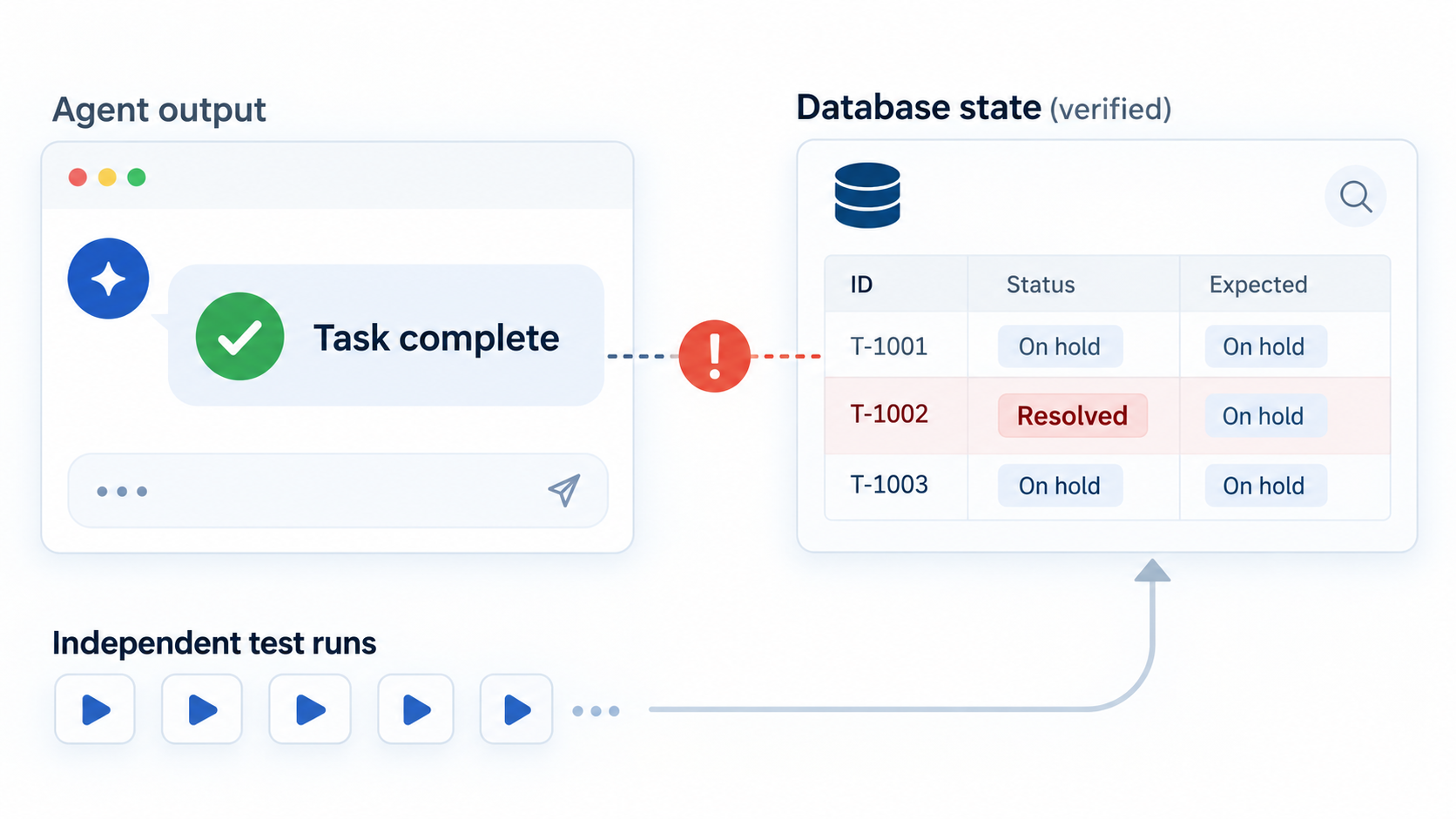

An agent can make valid tool calls, report success, and still leave a business workflow in the wrong state. ThinkingBox is designed to test the outcome, the side effects, and whether the result holds across repeated runs.
Microsoft and Hugging Face introduced ThinkingBox and ThinkingBox-Bench on October 3, 2026. The sandbox evaluates agents on stateful business workflows by checking the backend state and side effects left at the end, rather than treating a fluent answer or successful tool call as proof of completion. The benchmark contains synthetic workflow reconstructions; its examples do not represent real customers. Read the Microsoft and Hugging Face article.
Why a correct-sounding answer is not enough
Imagine an agent that updates a service ticket, then tells the user the issue is resolved. The message may sound reasonable and every tool call may have returned without an error. But if the ticket was supposed to remain open for another team, the workflow has not reached its required outcome.
That difference matters whenever an agent can change records, create tickets, update orders, or trigger other actions. Logs show what the agent attempted. A final-state check shows what actually changed. Both are useful evidence, but they answer different questions.
ThinkingBox formalizes this distinction. A task defines an initial backend state, a user goal, available tools, applicable policies, and executable checks for the final state. The environment can also identify side effects so an evaluator can detect required changes that did not happen, incorrect changes, and extra changes that should not have happened.
Measure outcomes and repeatability separately
The Microsoft and Hugging Face release describes 507 synthetic workflows across retail, auto insurance, travel, neobanking, and consulting. Each task is run 20 times from an isolated starting state. The repeated trials make it possible to distinguish a task an agent can complete once from one it completes consistently under the benchmark's conditions.
The article also reports a common-set ablation across 12 models: 79,853 of 121,680 valid trials failed executable checks. This is a result from that particular benchmark comparison, not a forecast of production failure rates. The number is useful as a reminder that an agent can finish without a tool error and still fail the task's required state checks.
When reading any agent benchmark, look closely at what its metrics mean. “Passed at least once,” “passed on a typical run,” and “passed every repeated run” describe different properties. A single aggregate score can hide that distinction, and benchmark performance does not guarantee behavior in a different system, policy, or data environment.
A practical evaluation pattern
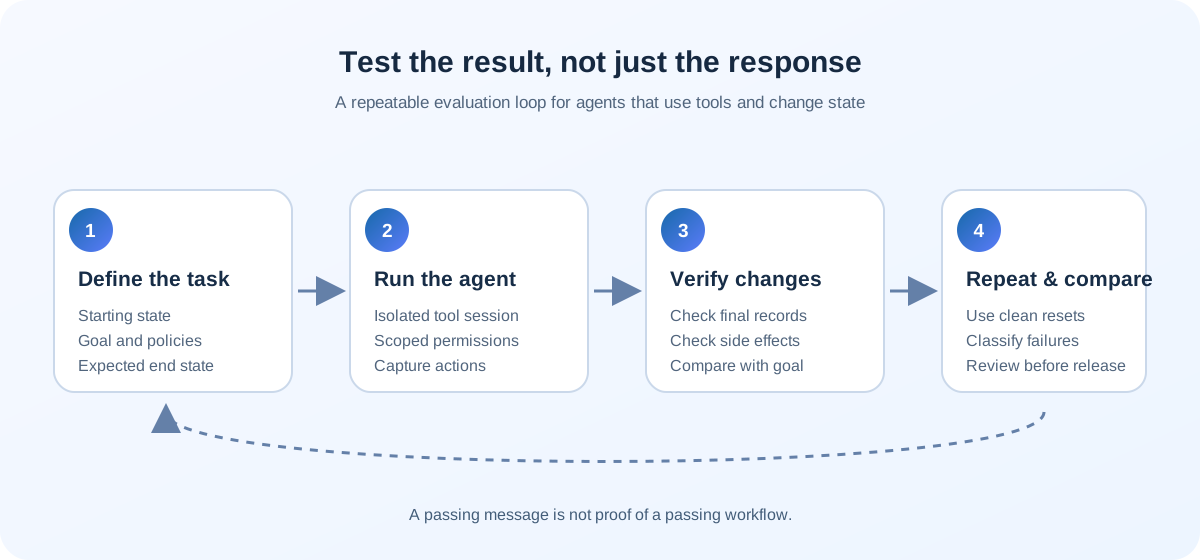
Teams can borrow the evaluation discipline without adopting the benchmark. Before testing an internal workflow, define:
- The starting state: the records and conditions the test begins with.
- The desired end state: the exact fields, status, or records that must be true when the task finishes.
- Allowed and forbidden side effects: what may be created, changed, or left untouched.
- Independent checks: how the system will verify the result without relying only on the agent's own summary.
- Repeat conditions: which representative cases to run again and how to compare outcomes.
- A release boundary: which changes require human review, especially if they are difficult to reverse.
For example, an invoice workflow might need to verify that the correct invoice was matched, the intended approval status was recorded, no duplicate payment request was created, and an exception was routed to a person. A message saying “invoice processed” is not a substitute for those checks.
Where the benchmark helps, and where it does not
ThinkingBox is useful as a concrete example of outcome-oriented evaluation for tool-using agents. Its isolated sessions and executable checks support repeatable comparisons under a defined test setup. The authors also describe the released benchmark tasks as synthetic reconstructions, so readers should not mistake them for customer data or evidence about a particular deployment.
The benchmark cannot certify an agent for an organization's live environment. Real systems have different permissions, integrations, policies, data quality, and failure modes. A team still needs its own representative test cases, access controls, monitoring, and human approval rules. The source article's reported benchmark results are not a substitute for that work.
The takeaway
ThinkingBox puts a useful question at the center of agent evaluation: did the workflow leave the system in the required state, without unintended side effects, and can it do so repeatedly? That is a stronger test than checking whether an agent's answer sounds confident.
For a practical pilot, choose one bounded workflow, write down its expected state changes, and verify them independently across repeat runs. Keep irreversible actions behind a clear review gate. Those steps make failures easier to see before an agent is trusted with live work.
Further reading
- The Microsoft and Hugging Face ThinkingBox announcement
- Microsoft's ThinkingBox framework
- ThinkingBox benchmark data
- GitHub Copilot dynamic workflows: put a repeatable process around agent judgment
- Fabric IQ: use the semantic model as a contract for Copilot answers
Editorial note: This article summarizes a public benchmark announcement and offers an evaluation checklist. The benchmark workflows are synthetic. No ThinkingBox environment or customer system was run for this article.