Fabric IQ: Prepare Power BI Models for Copilot
Learn how Fabric IQ connects Copilot to Power BI semantic models, and how to test definitions, data freshness, access, and answer quality.
Harllens George | 2026-10-06
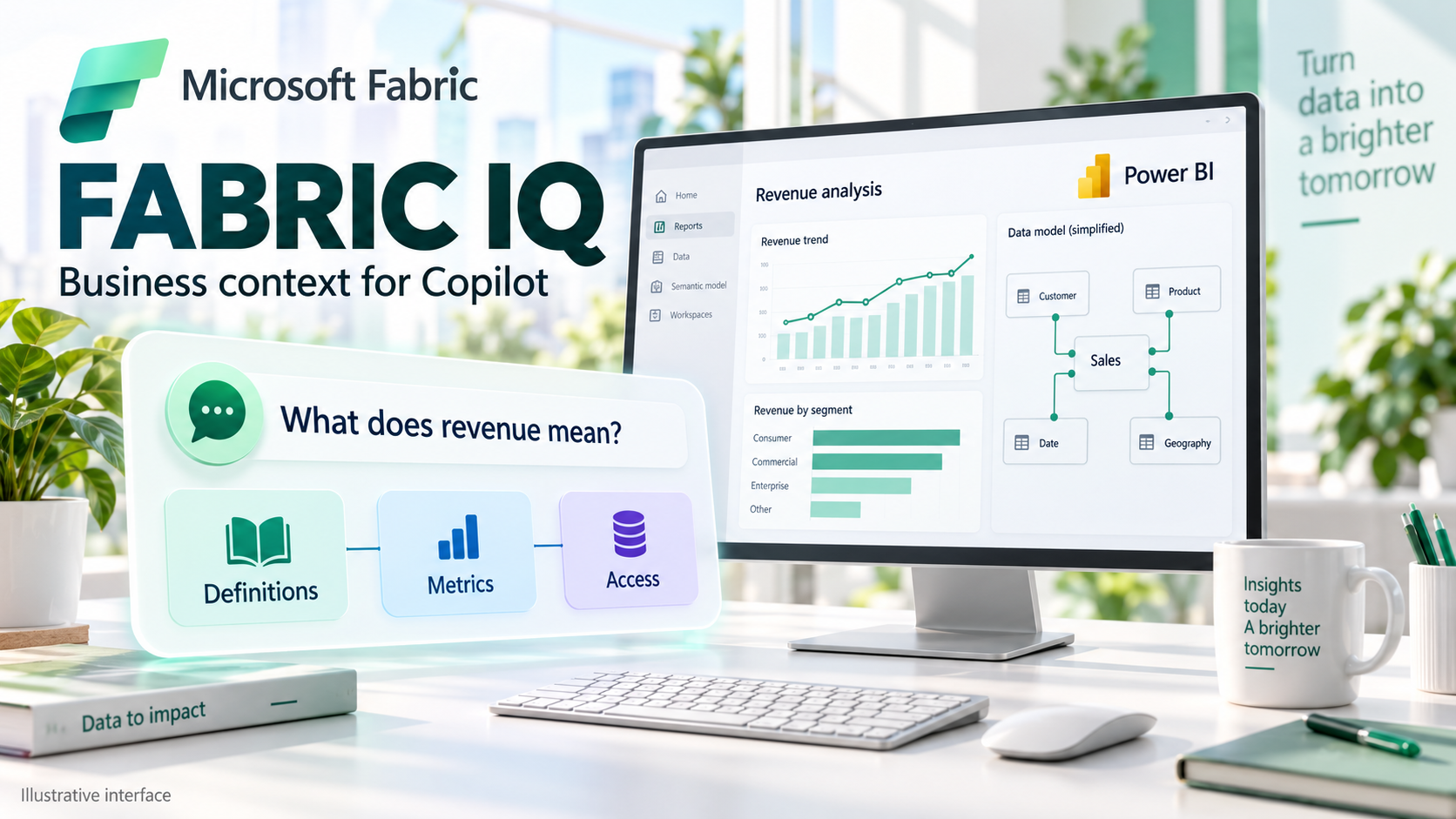

An AI answer about revenue, backlog, or forecast is only useful if the organization agrees what those measures mean. Microsoft's Fabric IQ announcement puts that business context, including Power BI semantic models, at the center of its Copilot direction.
Microsoft's September 28, 2026 announcement says Fabric IQ brings governed business context into Copilot through Power BI semantic models, metrics, relationships, and business definitions. The post calls Fabric IQ in Copilot Chat and Cowork generally available, while IQ Sharing is in preview and integration with the new Code experience is coming through Frontier. These are Microsoft's stated product statuses, not a check of any customer's tenant. Read the announcement.
The practical point is larger than a new feature name: a model needs shared definitions before a conversational interface can reliably answer business questions. A semantic model can provide that agreed vocabulary, but it cannot repair unclear ownership, a stale refresh, conflicting definitions, or a badly framed question by itself.
Why business context changes the answer
Consider a manager who asks, “What is our latest sales forecast?” The answer depends on more than retrieving rows. It depends on which forecast measure is approved, what period “latest” refers to, which organizational scope is in view, when the source last refreshed, and whether the person asking may see that data.
Microsoft describes Fabric IQ as grounding Copilot experiences in the Power BI semantic foundation that organizations already use for metrics and business definitions. That is a vendor description of the intended experience. It does not prove that a given model is complete, that every question will resolve unambiguously, or that every tenant has the same feature access.
Treat the semantic model as a contract between data owners, report authors, and AI experiences. The contract is only useful when people can explain its definitions and test whether the answers match them.
Check readiness before a Copilot pilot
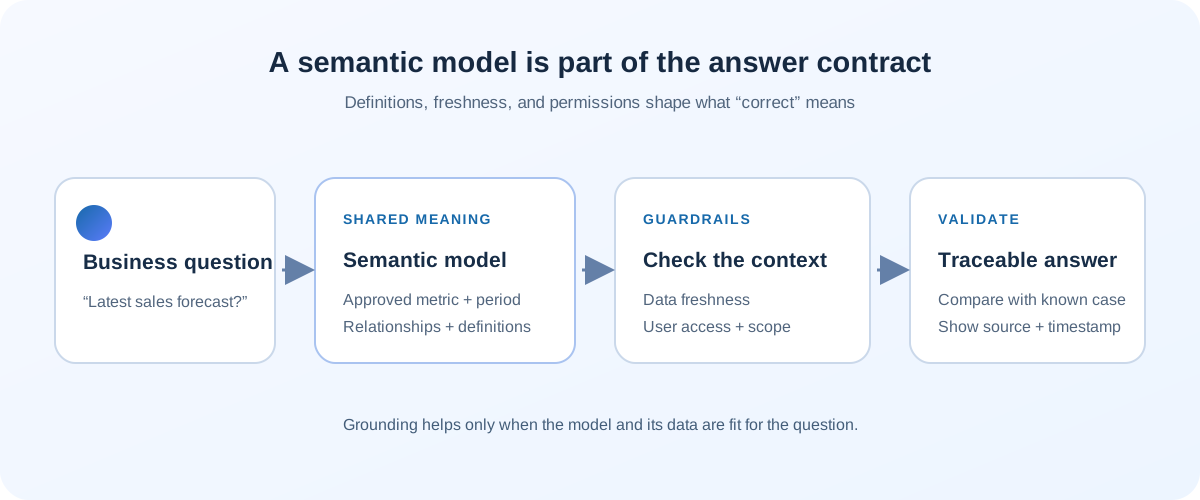
Choose a small set of recurring questions and document the expected answer path. For each question, record:
| Check | What to make explicit |
|---|---|
| Business meaning | The approved definition of the measure and any terms that are easy to confuse. |
| Model mapping | The semantic model, measure, relationships, filters, and time period that should answer the question. |
| Data freshness | The expected refresh time and how an operator can tell whether the underlying data is current enough. |
| Access boundary | Which user roles may see the information and how the same question should behave for a restricted user. |
| Expected result | A known answer or acceptable range for a representative test case, with its source and timestamp. |
| Ambiguity handling | What the experience should do when the question lacks a period, uses an undefined term, or spans multiple definitions. |
Start with five to ten questions that business users already ask. Include a straightforward metric, a filtered comparison, a question with an ambiguous term, a period-bound question, and a question tested under a restricted role. A reviewer should be able to trace each response to the approved model and distinguish a data issue from an interpretation issue.
This is a proposed evaluation method, not a report of a Fabric IQ test. Microsoft's announcement says access controls and governance are preserved by the described integration, but organizations still need to verify the actual experience, permissions, data freshness, and rollout in their own environment before relying on it.
Keep the feature states separate
Microsoft's post groups several data and AI announcements together. They should not be collapsed into one availability claim:
| Capability in the announcement | Status Microsoft stated | What to verify |
|---|---|---|
| Fabric IQ in Copilot Chat and Cowork | Generally available | Current tenant eligibility, product documentation, licensing, region, and administrative controls. |
| IQ Sharing in Fabric | Preview | Preview access, scope, governance behavior, and limitations before designing dependencies. |
| Integration with the new Code experience | Coming through Frontier | Frontier eligibility and current rollout details; do not plan it as generally available. |
Product status can vary by tenant, geography, entitlement, and rollout. Check current Microsoft documentation and tenant notices before a delivery commitment. The announcement alone is not proof of access.
Common mistakes to avoid
Treating natural-language answers as a new source of truth. Keep the approved semantic model and data owner authoritative. Make the answer traceable to a measure, definition, and data timestamp.
Assuming “grounded” means correct. Grounding can help align an answer with a governed model, but the model itself may contain incomplete or disputed definitions. Validate against known examples and investigate mismatches.
Testing only as an administrator. Include the people and roles who will use the experience. Confirm both the expected visibility and the intended denial behavior.
Combining preview and GA announcements. IQ Sharing and the Code experience have different statuses from Fabric IQ in Copilot Chat and Cowork in Microsoft's post. Track them separately.
Promising the feature before checking the tenant. Confirm licensing, region, policy, rollout, and data readiness in the target environment before setting a launch date.
The takeaway
Fabric IQ's announcement reinforces a useful architecture principle: Copilot over business data needs governed semantics, not just a connection to more tables. The semantic model can give measures and relationships a shared meaning, while the team remains responsible for data quality, access, freshness, and validation.
Before piloting, choose a handful of real business questions and write down the approved measure, model, freshness expectation, access boundary, and known answer. If those are hard to define, improve that foundation before expanding the conversational layer.
Further reading
- Microsoft's Fabric IQ and data innovations announcement
- Practical Power BI updates for August 2026
- Copilot Home, Code and Autopilot: a team checklist
- Dataverse and SharePoint document permissions
Editorial note: This article explains Microsoft's public announcement and proposes a readiness checklist. No Microsoft Fabric or Copilot tenant was accessed or tested for this article.